(The following is a blog I wrote for the Paavima website. You can see the official version, with pictures, here
I arrived in Colombo exhausted. Jason picked me up at the airport and whisked me through the empty night streets of Colombo. I spent most of the next day in a stupor, waiting for immigration to extend my visa and wandering slowly through the streets. The next morning we were up before sunrise, before heat and traffick could choke us, and on the streets, making our way south to Madiha.
Jason is interpreting the landscape for me as we go, telling me about the tsunami, stories about the passenger trains, the government legislation, about people and houses and the path of the great wave. We breakfast at Galle and are installed at the Beach Inn while it is still morning. It's nice to have a place to rest for awhile. And rest is exactly what I need.
For the rest of the week, with the help of Indika and a local community member, Mr. Fonseka, we round up the troupes. This only takes a few hours out of every day, at the most, and the rest of my time, I sleep and walk the beach and go for long swims in the ocean. The waves are breaking metres from my door, the food every night is divine. There is always sand between my toes and a nap in the afternoon in the hammock between the cocount trees.
I propose to start work on Monday, so on Sunday we need to clear a space. Some women in the community volunteer to help me and so we find ourselves at the ruins of the Polhenna school, just across the way from the Paavima Dive Shack.
As you can see from the photos, parts of the classrooms have been completely laid to ruin by the tsunami. There is a new school being built next door and for now, all the rooms of the old school are empty and full of rubbish. It looks as if someone is living in part of the building. I select a long, open hall for the classes. There is a blackboard at either end. The floor is concrete, but missing in patches.
They tell me that it used to be the village green, where children played sports. Now there is a pile of rocks there and big machinerary noisily moving the rocks to cover the beaches and the turtle's egg laying places for some reason only the government really knows about. We have to climb over the heaps of jagged rock to get to the classroom.
One of the empty rooms seems to be a kind of wharehouse for the furniture. The women and I carefully extract rusty old chairs and broken tables from the piles and send them over to a tap where another woman does her best to wash them. I am soon covered in sweat and rust, walking carefully along the floor where panes of glass have broken to avoid accidents in my silly little sandals.
It doesn't take too long. In the end we have about thirty chairs of various sizes and we have salvaged about nine desks. The women set these up in rows as neat and orderly as the uneven floor and the rusted furniture allows. I smile to myself. "I'll soon be changing that," I think. We haven't really said much to each other, my Singhala is nonexistant. But we have smiled a lot and laughed in the sunshine, and carried things together.
It's a good start, as far as I'm concerned, looking around at this strange place where I will be teaching English conversation for the next two months. The first general meeting for all students is on Monday and I am excited and nervous to see who will come and what will result...
Monday, October 30, 2006

Tuesday, October 17, 2006
Attack on Galle
On Sunday, I went on the first of my weekend adventures in Sri Lanka, boarding a packed local bus blaring Hindi top 10 hits, for a fast forty minute ride along the coast to the old French fort at Galle. It was a beautiful sunny day. My shoulders are brown from the sun. My friend Adam and I walked along the old ramparts, trying not to disturb the many couples cuddling under umbrellas among the old stones. The water below the old stone walls was clear: beautiful shades of blue and green, sparkling gold reflections, shimmering fish sliding through the cool water. We descended old stone steps down to a tiny strip of sand outside the wall and took off our shoes to wade barefoot there, skipping stones across the water.
This morning I was eating breakfast when the word came. The hotel owner came in shouting something. I heard him say "Galle" many times. At last, he came over to speak to us. "Galle has been attacked," he said, almost breathless.
The news trickled in slowly. I don't have CNN here and I don't trust the information that gets passed around by mouth in these kinds of situations.
Until today, we have been able to say, "the attacks are in the North, but we are in the South. We are safe here." But that is no longer the case.
Word of mouth (and I warn you, it is unreliable) reports that Galle was attacked by a coordinated effort from LTTE boats and guerrillas hiding in the nearby mountains. Smoke bombs were fired into the Naval base at Galle. While I had coffee it was reported that there was at least one death, with fighting ongoing. Sri Lankan men staying at the hotel gathered near the beach wall looking West towards Galle. It is far too far away to see anything. I could have told them that even staring directly at the wreckage, they wouldn't find many answers.
The road from Matara to Colombo passes through Galle, very close to the Naval base. I imagine it's closed today. It sounds rather ridiculous and overdramatic, but my route to the capital is cut off. The Eastern road has been impassable for some time now, the city of Tricomalee is also unsafe and currently closed. But, if all else fails, and it is extremely unlikely that it would come to this, I have, after all, my trusty little moto (which to be entirely honest, isn't really all that trusty,) and maps of the back roads, inland through the mountains to Colombo. I also have a safe house on the hill with good friends I can stay with and a huge library full of good books :)
LTTE attacks and government counter attacks have been intensifying. The newspapers reported that the military mounted an offensive one day. The next, the bombing of several bus loads of civilians by the LTTE made front page. One newspaper reported 95 Sri Lankan soldiers died yesterday in a suicide bombing in the northeast. It's strange to read newspaper reports, dated today, October 18th, reporting in the past tense about something that his happening or only just finished happening. Already some official is being quoted as saying that two navy boats were damaged and three rebel boats blown out of the water.
Whatever is going on in Galle, it doesn't mean anything good. The LTTE has sent a powerful message today: a message that speaks so many words to people all over the world. It tells the government that the LTTE's power is not limited to the North. It tells civilians everywhere that terrorism could strike at any time. It tells potential tourists worldwide, as if they needed another reason, that they should definitely stay away from Sri Lanka. Galle is one of the major tourist areas on the island and I doubt anyone will be flocking there any time soon.
I live in a small town of absolutely no strategic importance. There is absolutely no reason for any violence to take place here. For the most part, I live my life in a small circle between the beach, the Polhena school and the Rohanna school with occasional trips into Matara for the internet and grocery shopping. I am in a safe place, I want you all to know that. I am also being a safe person. I am registering online today with the Australian embassy and I will not hesitate to hop a flight home if things over here get messy.
Drinking the last of my coffee I watch large gray gunboats speed across the horizon far away, moving from the second naval base in Tangalle, west to Galle. I am wondering what I am doing here. It was never me who was interested in war. It was my brother who had all the books on World War Two, who was fascinated by the medals, who collected all the Desert Storm trading cards. Now he is happily married with a dog and a house is Saskatoon and I am out here, still on the edges of shadowy things.
Thursday, October 12, 2006
Colombo
A Brit named Jason picked me up at the airport and drove me to his house where I fell quickly into a deep sleep. I loved his home immediately, even at midnight as I first arrived. It had a curving stairway in the foyer and a pool just outside.
In the morning, after a cup of tea, I took a trishaw into the city. I sat in the back of the little ricketdy contraption and loved the blur of traffick, heat, dust, crowds and signs filling my view. There were new sounds, new tastes, new smells, new textures to experience and I had a huge smile on my face.
I spent the morning in the immigration office getting my visa extended. It was fairly boring with very little to note except the moment when one clerk in the long line of clerks to be seen, entered the information from my form into a computer and paused. He said something to the clerk next to him in Singhala. The clerk looked at me and said calmly, "It seems your name is on the Black List."
They conferred and typed more things into the computer then gave me back my form and told me to go to a certain office. I went to the office feeling a little nervous. "But it's my first time in Sri Lanka," I said to the clerk. He nodded and motioned me towards the office.
It must have been a mistake because in the office someone hardly looked at me and certainly didn't look at my form before stamping it and sending me back into the line of clerks. I suspect there is some subversive woman out there who shares the name name, perhaps even the same nationality as me. Not only am I not subversive, but I am travelling on a brand new Australian passport. Australian Jen has hardly had a chance to break any laws yet.
I walked around Colombo a little bit but the heat and the dust and my fatigue got the most of me. I was walking along the concrete pathway by the ocean next to the "famous" Galle Face Green when a man engaged me in conversation. Galle Face Green was, perhaps, at one time green, but now it is a dusty patch of ground with hardly any grass, fenced in for some rehabilitation project that, according to the sign, should already be finished.
The man is chatting with me, the usual conversation about where I'm from and all that, and I'm only half paying attention. We get to the end of the promenade and we pause. "Where are you going?" asks the man. I'm not really going anywhere, but I point in one direction. "Don't go that way," he says, "there is nothing down there. Come here, I will get a trishaw to take you to the Cinammon Gardens. YOu will like that." And before I know it, he has hailed a trishaw and is giving directions to the driver. I thank him and get in, after all, where else do I really have to go, but as the driver takes off, the man jumps in too.
I'm not terribly comfortable with the situation, but I can always stay with the driver. Meanwhile the random conversation continues.
"You have travelled very far?" the man asks me. "Perhaps you are very tired?" I nodd my head absentmindedly. "Perhaps you would like a nice massage?"
"Massages are good," I say, "I just had a nice one in Thailand. But massages are very expensive."
"Ah, perhaps you would like a free massage?" He asks.
"No, I would not," I reply firmly.
"Why not?" asks the man.
"Because where I come from, we often say that nothing in life is really free."
"Perhaps what you need is a good massage from a very good friend..." he suggests.
Now I am definitely wary. It's clear where this is going. "No," I say very firmly.
"Oh well, at least, we can go to the Cinammon Gardens and drink a beer together. It's very romantic there..."
"I can't drink beer," I say. "I'm taking antibiotics. I have a very nasty infection."
A certain look crosses his face. Although I don't know it at the time, even by suggesting we drink alcohol together he is implying that I am a whore. Women in Sri Lanka, "proper" women, I mean, do not drink. Most especially alone with a man. If he thinks I am a whore, my random comment about having an infection must have hit a good mark.
At that moment, just as I am wondering what on earth I can do to get out of this situation, the trishaw enters some heavy traffick and luck is in my favor because for some totally avoidable reason, the trishaw then proceeds to crash, at slow speed, into the fender of a stationary car ahead of us.
"You know," I say, trying not to laugh, "I think I'll get out here." And I do, walking quickly down the streets in no particular direction, leaving behind the sound of traffick and shouting voices.
Getting to the Jet Plane
Backing up a little between my posts from Australia and my posts from Sri Lanka...
I spent four days in Bangkok for yet another round of goodbyes to good friends. I was already tired when I was walking the streets of Sydney. I often had to stop and rest, even nap in parks, while exploring. By the time I left Bangkok I was nearing exhaustion, and the great parties we had over the weekend only contributed (though how could anyone possibly resist?)
I said my last goodbye on the street at the end of the alley outside the hotel. Before I could think too much about who I had left behind, the taxi had whisked me around the corner out of sight and into a sludge of traffick.
We inched forward and then ground to a halt. Cars filled in the gaps around us. We were mired. I tried to relax and practice good Buddhist thinking, abandoning myself to the moment. "What will be, will be," I todl myself, resisting the strong urge to swear. I had already left a little later than I should have. I needed all my minutes.
Minutes kept ticking by. I watched them on the meter. Still, we didn't move.
It took up 45minutes just to travel one kilometre. My thoughts were now entirely diverted from sentimental goodbyes, and fixated on the time. Would i make it to the airport?
One of the problems, you see, is that Bangkok just opened a new airport. Actually I flew into it from Syndey on the first day that it opened. The old airport was an old, ugly, place where it often took two hours to get from your plane to the outside world and which was voted the worst place for a layover of all the international airports. The new airport is this monstrously huge cavern of concrete and blue light. Only that morning I had read in the Bangkok Post an article begging people to stay away from the airport. So many Thai people were driving out to see it that there were serious traffick jams. People were parking on curbs to eat picnics and admire the view. The article quoted many people who expressed their pride in such a large, modern, international building. One man said he would now save up so that his family could fly on a plane and use the airport.
Not everyone is so happy however. Imagine that you are the owner of an "airport hotel" and the airport is no longer there. Now you just own a hotel in the middle of nowhere. Taxi drivers are happy to get huge fares to the very distant airport. In addition, there is a surcharge on all taxis leaving the airport. For the rest of us, there aren't even any public transportation options. And the airport is a long long way away.
And I wasn't even one kilometre closer to it. Buddhist mentality gone, I started to swear. Traffick began to inch. "This is good!" said my driver with a cheery smile. "Slow is good. Stop is bad."
I tried to smile back but all I could think was, "Slow is not good if I miss my plane."
It was agony. We got through the snarl and I started to relax, only to be caught in another jam, just minutes down the road. I tried to find solace in the bumper to bumper frozen pack of cars in the opposite lane which went on for over 5 kilometres but it didn't help me travel any faster.
When traffick opened up for good, we were still miles from our destination. The last twenty minutes (thank god there were no picnicers blocking traffick at that hour) we travelled at high speed down newly build wide paved roads. I could see the airport but it still took ages to get there.
The taxi dropped me at the terminal at 8:15. My flight was for 9:00. If there was no delay in the flight, I thought, I will have already missed it.
"Is this the place?" I asked. "I don't see the Sri Lankan Airways sign."
"Yes, yes," said my driver, kicking me out. Quite likely he was tired of my swearing.
I grabbed a trolley and raced inside, looking up my flight on the screens. No delay but the check in counter, located in area "R" was still open. I looked around the huge concrete warehouse of international departures. I was in area "L."
"Well," I thought, "there may still be a chance." So, I grabbed the trolley and began my wild race through the crowded hall. Though I couldn't see myself, in my mind, it was a thing of beauty. I dodged and weaved through hoardes of milling people, skidding to sudden halts, accelerating rapidly where possible, trying to convey this desperate sense of speed to those in front of me.
I was breathless when I reached section "R." I turned the corner to the airline counters, expecting to see the impatient faces of clerks checking in those last irresponsable stragglers such as myself with warnings of, "If you don't hurry you won't clear security in time."
Instead, my jaw dropped. There were three counters still open for the flight and they were all packed with people: a group of about ten men to be precise, all with the hugest amount of luggage I have ever seen. Large parcels wrapped in purple plastic were piled on carts filling the space in front of the counter. I got dutifully in line, my fear now very real. It was 8:30. The flight should take off in 30 minutes. I still had airport tax to pay, immigration to clear and security to pass.
After a few tense minutes, I approached a free counter person with what I expect was the most desperate of expressions on my face. "Is it still possible to make the flight?" I asked.
He took care of me personally and before long, I had rid myself of my bags and was darting towards the airport tax station with my boarding pass in hand. They opened a new immigration counter just as I arrived and I breezed through in minutes. It was silly for me to have worried about security, in Bangkok, it has always been a bit of a joke. At the gate, I went through a metal detector, but there was certainly none of the hysteria surrounding liquids or nail sissors or anything like that.
Never the less, I sat down in my seat and checked my watch. It was just 9:00. I had made it.
Friday, October 06, 2006
Interview with Jennifer
The following are questions I answer a lot, so I thought I would write the answers down.
1. What brought you to Sri Lanka?
2. Where are you?
3. What will you be doing?
4. What are you doing to do for fun?
That's right, this is supposed to be some kind of vacation, so hopefully I do have lots of free time. Considering that everyone wants to work with me at 3pm, it seems I have all of my days pre-noon available, at the very least.
I am staying at the Beach Inn. Every morning when I open my eyes, I hear the sound of waves and every day when I open my door, I see them. They're right there, only metres away from my door. On my first morning, i went for a swim and yesterday a long walk on the beach.
In addition to learning sign language, I also brought along JoJo, my trusty guitar. I bought it and started learning about a year ago but stopped after work and my social life got me too busy. Now I'm hoping for some quiet afternoons practicing chords. Dont' expect a musician anytime soon.
In two weeks the seas will be clear enough to do some diving. The project has the equiptment and some guys from the dive class have volunteered to take me out. That should be fun. That is, after all, one fo the main reasons I'm here.
One of the guys, Indika, who helps me out with just about everything, has also volunteered to lend me his surf board. I think hours of spills and giggles are in store for me there. Yes, I know you need upper arm strength to surf, not to mention a million other muscles I don't have, but hey, I'll give anything a shot.
Now, I admit, I spend almost every afternoon sleeping. But, hey, I'm on vacation.
Between the teaching, the talking to people, the walking, the writing, the learning, the sleeping, the reading and all these water sports, I think my time will be full.
5. What next?
1. What brought you to Sri Lanka?
While hiring for teachers last February, I came across a posting on an ESL website for volunteer teachers on a tsunami project in Sri Lanka. For some reason, it just caught my imagination. I was planning to quit my job in Thailand in June and I was looking for something to do. I emailed the address on the posting and waited. No answer. Deciding to persue the idea, I googled volunteer teaching opportunities in Sri Lanka and finally got in touch with Paavima.
The Paavima project works mainly with local fishermen and acquarium divers, training them to become professional divemasters and dive instructors. This allows the people who are currently diving for acqurium fish to do so safely (previously they were blacking out and getting the bends, doing as many as five consecutive dives at a time without breaks at the surface) and also giving them an alternative to reef exploitation. By bringing tourist divers into the region, local divers have incentive to keep interesting fish in the water and not capture and sell them.
Needless to say the project appealed to me, I exchanged emails and we decided that October and November, months just following the monsoon, would be suitable times for my work here. The rest of the project won't really get underway until December, so, for now, I'm on my own.
2. Where are you?
The project is based in a very small town called Madiha. You probably won't find it on a map. Polhena is the nearest larger town. It's not as if these are discreet places, however. It takes me less than five minutes to walk to Polhena.
Madiha is on the southern coast of Sri Lanka, about a four hour drive, or 200kms, from the capital city of Colombo. There is no fighting in this region, nor has there ever been any bombings or LTTE conflict.
I will write more in deapth about the impact of the tsunami on the village later. For now I am still taking it all in, still processing what I see and fitting it together with what I hear. Two years later though and it is still a main topic of conversation, still very evident on the landscape of people's lives.
3. What will you be doing?
Initially I thought I would be teaching English to the fishermen learning diving with the Paavima project. Actually, they will be only one of the classes I will be teaching. With them, the goal is to get them comfortable having conversation with foreigners. As the project produces more dive masters and instructors and after the underwater memorial is built, the project will become more of a local business, with the local divers taking tourists on dives and training them for their certifications. They will need English to do that and that's where I help out.
In addition, though, trying to show that the project is interested in the greater community, we offered English classes to those interested in Madiha and Polhena. I got a list this morning of over 50 children who will be showing up on Monday. "Actually," I was told, "there is probably more than 70."
In addition to the children, I will also be offering classes to their parents, and I'm hoping here to work mainly with mothers. So much, for what I can see, of the tsunami work has been focused on men and their livlihoods and that's great. I'd like to see something given back to the women as well. My mission though, is to discover how using English can be meaningful in their lives. That is, of course, assuming that they show up and that I can keep their interest.
The other two groups I will be working with are at the Rohanna Special School, about two kilometres from where I am staying. The Rohanna school is a school for children who are deaf or blind or mentally disabled, although the majority of the students are deaf. The school has recently received a significant facelift from a local ex-pat and humanitarian who visited and was appalled by the conditions there. Although the teachers recieve government salaries, the children at the boarding school are subsidized about 50cents each per month... you can imagine that doesn't go very far towards even feeding them, even here, let alone maintaining facilities...
If you are interested in reading more about the school, I suggest you check out Adam's blog for more details. Adam is an American who is volunteering at the school and he has some interesting observations.
For me, it is a place that instantly captured my heart. I started learning Singhalese sign language immediately. My fingers are still clumsy, they are still learning how to speak, as it were, and I make lots of mistakes. Still, picking up the sign language is far more accessible to me than the spoken Singhalese. I'm having trouble just pronouncing names. And there is something about the children and the people I have met that makes me want to speak. Even more powerfully, that makes me want to understand how they speak.
4. What are you doing to do for fun?
That's right, this is supposed to be some kind of vacation, so hopefully I do have lots of free time. Considering that everyone wants to work with me at 3pm, it seems I have all of my days pre-noon available, at the very least.
I am staying at the Beach Inn. Every morning when I open my eyes, I hear the sound of waves and every day when I open my door, I see them. They're right there, only metres away from my door. On my first morning, i went for a swim and yesterday a long walk on the beach.
In addition to learning sign language, I also brought along JoJo, my trusty guitar. I bought it and started learning about a year ago but stopped after work and my social life got me too busy. Now I'm hoping for some quiet afternoons practicing chords. Dont' expect a musician anytime soon.
In two weeks the seas will be clear enough to do some diving. The project has the equiptment and some guys from the dive class have volunteered to take me out. That should be fun. That is, after all, one fo the main reasons I'm here.
One of the guys, Indika, who helps me out with just about everything, has also volunteered to lend me his surf board. I think hours of spills and giggles are in store for me there. Yes, I know you need upper arm strength to surf, not to mention a million other muscles I don't have, but hey, I'll give anything a shot.
Now, I admit, I spend almost every afternoon sleeping. But, hey, I'm on vacation.
Between the teaching, the talking to people, the walking, the writing, the learning, the sleeping, the reading and all these water sports, I think my time will be full.
5. What next?
December 1st I fly to London. I don't have tickets onward from there, although I'm hoping to remedy that soon. Ideally, I'll move onwards to Montreal by the 6th, and Calgary by the 13th. I'm aiming to be back on the border by early January, probably January 5th. But, hey, anything could happen.
Well that took quite a while, hopefully that filled you in. Any more questions, you can use the comment feature on the blog, or email me. I always love hearing from you, whoever you are.
Madiha
This ball has come to rest, for two months only, in Madiha. Madiha is a small, small town on the southern coast of Sri Lanka. You won't find it in the Lonely Planet or the Rough Guide. You will find the nearest other small town, Polhena, and the nearest medium sized town, Matara, where I am now using the internet.
My address, for anyone who feels post-minded in the next short period of time, is very simple:
Jennifer
Beach Inn
Beach Road
Madiha - Matara
Sri Lanka.
I welcome and return almost all my post.
There is so much going on right now and limited internet time but I promised to blog once a week for the project and will do so once things are up and running. For the last couple of days, a part from napping, we have been trying to round up the troops and see who is interested in my English classes. On Sunday we will try and do something with the classroom: an old school wrecked by the tsunami. On Monday things begin in earnest. Before then I have to learn at least the British alphabet in sign language, if not a few more sign vocabs. I've picked up about ten singahelese signs already and that's only the beginning. Starting Monday, two of my classes will be at the Rohanna school for the deaf and blind. So much to learn, so little time... more on all of this later, with links.
Wednesday, September 27, 2006
Long Lost Australia
My flight arrived in Sydney at 6am, descending out of the clouds and a gorgeous sunrise into the city, but my window was on the wrong side to see the view.
It took me a moment to realise that the shorter immigration line, the one for Australian passport holders, was mine. I went through with a big smile.
I sat in a cafe just outside Central station for breakfast, enjoying coffee and Australian bacon (huge salty slabs of meat, no fat, all meat) and the view. What made me smile was the realisation that not only had I come to a place where I was not labeled and pointed at and thought of as a foreigner (as I am in Thailand), but that it would be difficult in Sydney to determine who, if anyone, is a foreigner. People of all skin colors and appearances and clothes walked by, all seemingly intent on their business. Even an oversized backpack was no indication of foreigness, as half the backpackers travelling Down Under are Australians themselves. I sunk into anonymity with bliss.
In my mind, I was still converting everything to Thai bhat but I quickly had to force myself to stop, especially after paying more for one bed in an 8 person mixed dorm than I would for a luxurious suite in a hotel in Bangkok.
Despite my fatigue, I hit the streets.
At some point, after some wanderings of little note, I found myself in a very touristy place: Darling Harbour. There are many "attractions" there including a mall, an Imax theatre, and a lot of restaurants and hotels but that's not was attracted me.
It was a beautiful day, the sun was shining, the sky was this perfect brilliant blue and the breeze was delightful and cool. The city opened for me onto this wide open space with the towers soaring behind me in the background, the water in front of me and this huge sweep of brilliant sky above. Everything, and everyone looked bright and rice and happy and ... free.
I watched a little girl playing with her mother in a spiral fountain, their shoes off, their laughter echoing across the plaza and this sense of rich freedom (in combination with my sleep deprivation) and the beauty of the scene made me cry. There was this confused incoherent jumble of emotions bundled up inside me coming from somewhere I hadn't known about, where I had just been stuffing all these nameless emotions I didn't want to question for the last two years, and suddenly they were being lifted out of me.
I cried because I was exhausted and because I was exhilerated. I cried because I saw in this little girl playing in the fountain what is missing from so many little girls I've known over the last two years. I cried because I didn't see on anyone's face the fear and worry I've seen in people's faces for the last two years, because I didn't feel the fear and worry I hadn't even realised that I feel every day for the last two years. It struck me suddenly that I was in a place where no one would be calling my phone to tell me they'd been arrested, that my pleasure in the day wouldn't be sucked away by the passing of a black cage of a deportation truck passing on it's way to the border. And not only all that (and more) but I was in a place where those thoughts or possibilities are so unknown to people that they are almost entirely erased. I'll go back there soon and I'll take that bundle back, but for the moment, I felt it lifting from me and I glorified in the feeling of innocent freedom. I cried, but the tears were running out of my body straight from this strange place through me and out. I cried, but I was smiling.
I spent almost a week visiting relatives in a small town called Griffith which in a lot of ways, is like Mae Sot. People talk about the crops and the drought and the petty corruption of municipal government. I sat through morning tea and afternoon tea and a variety of visits with people I mostly didn't remember or hadn't, in fact, ever met, all of them very pleasant and lovely to chat with.
It was warm and comforting to be in the embrace of family, to let them care and pamper me, to sleep in big, soft beds and have long hot showers and to eat and eat and eat.
Everywhere I travel in this country, there are submerged memories bubbling to the surface. I remember cricket in my Aunt's back yard and a few rules of Australian footie and skipping rope songs. I remember the smell of roses in the air and dew underfoot on my Nanna's lawn. Things are smaller than in memory, things are bigger. I remember wattle and eucalyptus. I forget that the ocean is so icy at this time of year, and that the waves are so powerful until it's too late but I remember sand in my bathing suit and eyes and sandwiches...
Back in Sydney I felt like a little girl on a feild trip. It was my first time in the big city without my family and it felt wonderful. I spent my days walking and wandering the streets and exploring the city. I fell asleep on the sand at Coogee Beach and ate a "Burger with the Lot" on a cold windy day on the shore of Manly (The Lot, incidentally, includes fried egg, pinapple and beetroot, among other things).
And finally, it all came to an end and I woke up at 4am this morning to begin this new leg of my journey: four days in Bangkok, two months in Sri Lanka, a trip through London on my way back to Canada and back on the border for another round in January. If you want postcards, make sure I have your address and remember, I always love to hear from you, no matter how short the email.
In Transit, In Style
The moment I leave my home or hotel room for the airport, I step into a state of somewhat suspended animation. Some interior clock of mine gets set to "Wait" mode. For the next "x" hours, I know I will do very little of note, nothing productive. I will, in fact, be waiting. Waiting to check-in, waiting to board, waiting to land, waiting to clear immigration (thankfully not, Waiting for Godot).
Today I am waiting in style.
I once chided a good friend who slept in and spend a lot of money on a long cab ride, only to arrive at the airport and find his flight significantly delayed. "Who doesn't confirm their flight?" I asked, amazed.
Me, as it turns out. I woke up at 4am, shouldered my pack and navigated Sydney's complex train system to make my way to the airport for a 7:45am flight. I arrived with two hours until lift off, a bit tight considering the level of airport hysteria, security and other delays that prevent one from moving smoothly from check-in to lift-off. I recently saw almost two fist-fights in the immigration line in Bangkok, people, (who I immediately decided must be plain stupid) who had given themselves only an hour to get through immigration, customs and security. With relief I saw that the check-in counter for my flight hadn't even opened yet.
It was only when asking for a roll of tape for the box of books I am carrying that I found out why. The flight had been delayed almost five hours. I was given a coupon for breakfast and an invitation to the United Airlines Buisness Class Lounge.
That's where you'll find me right now: at 10am Sydney time, sipping a coffee and taking advantage of the facilities.
When i'm finished here, I might go check out the shower room. As it stands, I am the scruffiest person in the room, wearing jeans with messy pigtails. But what can you expect from a girl who woke up at 4am?
Monday, July 10, 2006
Marriage and Monkies: Kiwis sell everything
More fun from the wonderful world wide web.
Marriage
I can't even remember how I came across this link. I swear I was working. I was looking for articles on how to make good decisions so that I could work with our local In-Camp Coordinator on her decision making abilities. It was easy to find the usual articles with the usual steps (#1: Identify the Problem; #2: etc.) And somehow, this came up in my search.
Just scan it. It's fascinating. This guy has gotten all technical and pseudo-scientific about the improving the decision making process that leads towards marriage. I wonder how much of a marriage's success actually hinges on the decision itself. After all, there is that often used argument that arranged marriages have been known to be extremely successful and let's face it, the notion of romantic love hasnt' been around that long in the scheme of things, which means arranged marriages have been working for a long time. So, too, has domestic abuse, however, so it remains to be seen what "working" really means. I do believe that if people put more effort into the everyday work that goes into good communication and relationship building and less time in regretting their decisions, more romances would live longer. But what do I know?
Monkies
My brother was laughing with me online one day about those Ghost freaks in my previous post. I was feeling unmotivated about work. Another gray rainy Monday. So he sent me this. The Monkey Chow Diaries. It puts a whole new spin on eating rice for every meal every day, it really does.
"Kiwis would sell anything"
I guess a lot of people have been trying to make me laugh lately, which is good. I need to laugh more. I haven't had a real, uncontrollable giggle-fit in a little while. But this will definitely put a smile on your face. It's a copy of a posting on the New Zealand version of E-Bay, known as Trade Me. It's actually a hoax and Trade Me pulled the original posting. You can still find PDF versions floating around the internet though. The comments are especially hilarious. If you want to read about what a scandal the posting and hoax made, click here. A choice quote:
Hmmm, yes, when the comments section looks like this, I do believe the national reputation of New Zealander's is going to suffer:
Have a good week y'all. Hope you are laughing.
Marriage
I can't even remember how I came across this link. I swear I was working. I was looking for articles on how to make good decisions so that I could work with our local In-Camp Coordinator on her decision making abilities. It was easy to find the usual articles with the usual steps (#1: Identify the Problem; #2: etc.) And somehow, this came up in my search.
Just scan it. It's fascinating. This guy has gotten all technical and pseudo-scientific about the improving the decision making process that leads towards marriage. I wonder how much of a marriage's success actually hinges on the decision itself. After all, there is that often used argument that arranged marriages have been known to be extremely successful and let's face it, the notion of romantic love hasnt' been around that long in the scheme of things, which means arranged marriages have been working for a long time. So, too, has domestic abuse, however, so it remains to be seen what "working" really means. I do believe that if people put more effort into the everyday work that goes into good communication and relationship building and less time in regretting their decisions, more romances would live longer. But what do I know?
Monkies
My brother was laughing with me online one day about those Ghost freaks in my previous post. I was feeling unmotivated about work. Another gray rainy Monday. So he sent me this. The Monkey Chow Diaries. It puts a whole new spin on eating rice for every meal every day, it really does.
"Kiwis would sell anything"
I guess a lot of people have been trying to make me laugh lately, which is good. I need to laugh more. I haven't had a real, uncontrollable giggle-fit in a little while. But this will definitely put a smile on your face. It's a copy of a posting on the New Zealand version of E-Bay, known as Trade Me. It's actually a hoax and Trade Me pulled the original posting. You can still find PDF versions floating around the internet though. The comments are especially hilarious. If you want to read about what a scandal the posting and hoax made, click here. A choice quote:
SPCA national chief executive Robyn McDonald said the hoax was an irresponsible attempt at self-promotion at the expense of New Zealand's international reputation as a nation that cares for animals.
She had received hundreds of concerned emails and telephone calls.
"While the majority of these simply expressed their concern, there were also comments along the lines of Kiwis will sell anything. Even though the posting has now been revealed as a hoax, our national reputation will still have sustained some damage."
Hmmm, yes, when the comments section looks like this, I do believe the national reputation of New Zealander's is going to suffer:
I can't believe you plan on keeping this Dolphin in your pool unless someone pays you 10K. it's totally sick why don't you call the SPCA? If this is a joke then its seriously not funny.posted by: jodessfw (1 ) 1:50 pm, Tue 27 Sep
A dolphin isn't an animal - It's a FISH!
Have a good week y'all. Hope you are laughing.
Friday, July 07, 2006
Mum and Dad come to Town
 Almost all good adventures in Thailand start in Bangkok and that is where I met my Mum and Dad for the first part of their three week journey in Thailand. Although we have traveled (years ago) as a family in Singapore and Malaysia, the folks have never been in Thailand before and I was eager to show them where I have been living and working and playing for the past year and a half.
We settled ourselves in to enjoy Bangkok in luxury. There are many ways to enjoy BKK from the 150bhat guesthouse room with its hard mattress, thin sheets, thinner walls and shared toilet to the five star riverside hotels. I have been all over the spectrum, but for my parents, on their jet lagged arrival, after over twenty hours of flights and transit lounges, I used my NGO discount to book us into a classy joint, the Centrepoint hotel.
 From there we enjoyed a full buffet breakfast by the pool with our own omelette chef and fresh expresso coffee. We ventured forth from our air-conditioned wonderland to the mad hot world of downtown metropolitan Bangkok for several hours at a time, only to return to shower, nap, swim and enjoy cable TV.
My trips to Bangkok have been all business or all pleasure. I come for the food and the nightlife, to meet friends, to shop for foreign goods or else to attend meetings, conferences and workshops.
 I have been here over a year and not done anything on the usual tourist’s itinerary. Mum and Dad’s visit was the perfect excuse.
We made our way through the motorcycles on sidewalks, amoung the vendors, through the mad crash of cars, up the steep stairs to the expressway trains. We were whisked high above the city in air conditioned calm towards the river. The water was brown and rushed by, swollen by the rains and clogged with green debris from farms somewhere far away.
The Grand Palace in Bangkok is grand indeed. In the sunlight, it is almost blinding. You could spend hours there, soaking in all the detail and never really see half of it. In the shadowy alcoves around the edges of the temples there are oil paintings gilt with gold showing scenes from the Ramayana in exquisite detail. Tiny bells hang on the rooftops of temples, the tiles are all ceramic. Mosaics make up the gargoyles. Tiny sculptured figures peer at you from all kinds of unlikely locations. The air is full of incense and the scent of lotus flowers and the sun is bouncing off all the gold.

We wandered through the grounds, through the temple and in front of parts of the palace. We watched the changing of the guards and perused a large collection of ancient weapons.

By the time we found the exit, we were dripping with sweat, but after a brief interlude for refreshments, ready for more. We hopped across the river to Wat Arun, Temple of the Dawn.
Wat Arun is a beautiful mosaic decorated entirely with pieces of broken plates that have been donated by the inhabitants of Bangkok in order to gain Buddhist merit. Steep steps climb the edifice although visitors are only allowed to ascend to the first tier. From there, the view over the river is nice, but not as refreshing as the cool breeze on the hot sunny day. We lingered amidst the shady trees of the garden, ringing the deep bronze temple bells and sipping on cold drinks.

From Bangkok I had train tickets to Chiang Mai, Thailand’s second biggest city. Chiang Mai is to Bangkok what Ottawa is to Toronto or Canberra is to Sydney, only more so. It is quiet, without sky scrapers or sky trains. The City Centre is surrounded by ruins and a moat. There are plenty of cosy guesthouses offering courses in Thai massage, Thai cooking, treks, visits to the shooting range, tours with elephants. Unfortunately, the heavy rains had flooded sections of the train tracks and we arrived at the station only to find it packed full of people camped out on the marble floors waiting for service to resume.
We got a full refund, then hopped in a cab and made for the bus station where we were just in time to get the overnight bus to Mae Sot instead. Eight hours later, somewhere around 5am, we arrived at my home for the next phase in our adventure: Mae Sot, the migrant community, Umphang for trekking and Umphium Mai, the refugee camp where I work… (To be continued…)
 Arriving in MS (left)
 Bugs in market (right)
Monday, June 26, 2006
Are Ghosts Real?
I have just come back from a two week vacation and my life has been full and interesting and even, dare I say it, adventurous. It may seem strange then, that I am posting a random blog about ghosts. But writing about adventures takes some time and I really should be working, so for now, I am just sharing something that put a smile on my face.
Actually I am working. I am trying to find example essays which use definition in their introduction for a Writing class. Rather than wade through thousands of online essays, I thought I would search for an interesting topic and go from there.
My first attempt: coulrophobia (fear of clowns)
Since there aren't actually any clowns in the refugee camps, nor a tradition of clowning, I thought coulrophobia may not be the most appropriate essay topic to be reading about. So I turned to ghosts and the question: are ghosts real?
Paydirt. Lots of essays talking definining ghosts, poltergists, what have you.
Also lots of strange people. For example:
Are Ghosts Real? Answered by Greendayfreak on March 16th, 2006.
Are Ghosts Real? Answered by StarWarsFreak on May 20th, 2006.
I just wanted to share that with you because it made me laugh. Yay for the world, for the internet and for freaks everywhere!
Actually I am working. I am trying to find example essays which use definition in their introduction for a Writing class. Rather than wade through thousands of online essays, I thought I would search for an interesting topic and go from there.
My first attempt: coulrophobia (fear of clowns)
"Although there are no official statistics, some experts believe that as many as one in seven people experience some level of coulrophobia, as fear of clowns is clinically known. Symptoms can include shortness of breath, irregular heartbeat, sweating, nausea and overall feelings of dread.
In October, a plan to erect dozens of clown statues in Sarasota, Fla., a fabled circus town, was almost scrapped after an outcry from coulrophobes and clown-haters."
Since there aren't actually any clowns in the refugee camps, nor a tradition of clowning, I thought coulrophobia may not be the most appropriate essay topic to be reading about. So I turned to ghosts and the question: are ghosts real?
Paydirt. Lots of essays talking definining ghosts, poltergists, what have you.
Also lots of strange people. For example:
Are Ghosts Real? Answered by Greendayfreak on March 16th, 2006.
Ghosts are 100% totally real. i myself am a 13 year old school girl going to a normal school, but not many people realise i have amazing psychic abilities, and i can speak to ghosts. I speak to Sir Donald Bradman everytime i play cricket. he helps me out a lot. I'm really crap at cricket, but just yesterday, i bowled, and hit 3 wickets in a row! hooray to me! Ghosts are usually so cheeky. I don't actually see them. I see a glowing light no one else seems to notice. And i communicate to them by thoughts.
Are Ghosts Real? Answered by StarWarsFreak on May 20th, 2006.
ghosts are real. it says in the bible too.
exept it's mostly satan.
I just wanted to share that with you because it made me laugh. Yay for the world, for the internet and for freaks everywhere!
Saturday, May 20, 2006
The ants keep on marching...
It was another one of those nights. I came back home at night. The rain was glistening on the dark pavement and there was a cloud of insects swarming the streetlight just down from me. I hadn’t been home yet, so all my lights were still off.
I considered the possibilities as I opened my gate and walked up the stairs to unlock my door. But really, there wasn’t too much I could do. It was too dark inside to see without the lights. I turned on the porch light first, hoping to draw them away and keep them outside.
Within minutes of turning on the kitchen light, the room was full of the fluttering of those papery wings. Like most insects, these ones are not particularly bright. They are drawn to light and don’t seem to be able to navigate with much finesse. They slam into my arms and legs and when I try and brush them off, their wings fall off and they fall squiggling to the floor.
My cat (who is fat and pregnant and still very much a kitten herself) is going crazy. It’s kitty bonanza time over here. The insects are easy enough to catch.
Some call them flying ants, others call them termites. They are a fixture of rainy season. Luckily they are hatched after the first couple of rains and then we don’t see them for another year. They come out of the ground and fly around for a few hours. Then they drop their wings and crawl away to do whatever it is that termites do when they’ve lost their wings. If you know it’s a termite night, you put the lights on outside your house and keep them off inside. In the morning, you will need to sweep all the wings off the floor. I knew someone who had termites so badly that they couldn’t walk in the house after a termite night without sweeping first the drifts and piles of dropped wings from the floor.
Many people, of course, will drool and they read this because flying ants can be a delicacy. Without their wings, they really are a decent sized grub. And so easy to catch! All you need to do is set up a bright light and then catch them by the handful. I can see some of my friends drooling now. “It’s too bad it only happens once a year,” they say, shaking their heads.
But I am holed up in my mosquito net in the dark, listening to the wings outside and I just can’t wait for this year’s termite season to be over.
Monday, May 15, 2006
Smokin'
10:37am Tuesday, May 16th.
Here I am sitting at my desk with the drizzle coming down outside. I have my headphones on and I am trying not to feel frustrated as I attempt to recover a 50 page document I have been working on for the past few months which seems to have been lost when I took my clunky old laptop into the shop to get fixed. Incidentally, the laptop is far from fixed. It appears that they cleaned it of viruses and other than that only exacerbated the problems I have been having, including turning a 50 page document into one blank page of nothing...
I hear voices talking outside. Someone is hanging out on the small balcony behind the office. It seems like it would be more fun to be there than here, so I go out into the cool rainy day. Patrick and Mickey are smoking and brainstorming. I join them, feeling slightly jacked up on coffee.
"Can I have a cigarette?" I ask. They both look at me strangely.
"Uh, sure," says Mickey. "They're in my bag."
As I go to get them, I hear the boys talking, sounding slightly stunned. "What's she doing?"
I can't remember the last time I actually smoked a whole cigarette. I don't know why I'm interested now. I light up and stand outside with the boys. We laugh and talk, make plans, boot ideas around, watch the rain fall and the smoke drift away. I pull smoke into my lungs and feel the hit immediately. Half way through, I'm completely dizzy. Memories of trying to be a bad-ass in high school...
I stub out what's left and go back inside. I need to sit down. Back in front of my computer Pearl Jam is playing on the internet radio, my head is buzzing, I can hardly sit still, my fingers are flying across the keyboard and let's be frank: I stink.
But I've always wanted to have a smoke break. I think this was just my first.
Don't worry, it was also my last. I vaguely feel like throwing up now.
Your email inbox for 5/8/2006
Date: Thu, 4 May 2006 08:56:19 +0700
Subject: FW: KWO calls on UNSC to act on Burma
Date: Mon, 8 May 2006 08:17:47 +0700
Subject: FW: KRC April Report
Date: Monday, May 08, 2006 11:31 AM
Subject: Fwd: FW: Total number of IDPs in Karen State Now Over 13,000 People
Date: Monday, May 08, 2006 11:31 AM
Subject: Fwd: FW: Burma Army burns 8 houses in Htakotobaw Village
Date: Monday, May 08, 2006 11:34 AM
Subject: FW: Global Day of Action for Burma: May 16, 2006
Date: Mon, 8 May 2006 08:14:54 +0700
Subject: FW: Karen Humanitarian Relief Worker Killed by a Burma Army Land Mine
Date: Mon, 08 May 2006 08:01:22 -1200
Subject: NCUB Statement on Atrocities against the Karen People
Subject: FW: KWO calls on UNSC to act on Burma
The Karen Women's Organization today issued a public statement pleading for international women's organizations to press for an immediate United Nations Security Council resolution on Burma.
"Over the past several weeks, 13,000 people have been driven from their homes in eastern Burma, many in Karen state. Burma's military junta is on a rampage, killing women, children, and other innocent civilians. We desperately need women around the world to demand that the UN Security Council take action to end the violence in eastern Burma," said KWO in a statement. "If the UN Security Council turns a blind eye, many more women will die."
Over the past seven weeks, 13,000 people have been forced to flee their homes in villages in eastern Burma, an area of the world off-limit to journalists and non-governmental organizations. Over the past ten years, 2,800 villages have been destroyed of forced to evacuate by Burma's military junta, widely recognized as one of the world's most brutal regimes.
Refugees International, the respected human rights organization, reports that over 1,000,000 refugees have fled from Burma, and over 1/2 million remain displaced inside the country as internal refugees. In addition to the torching of villages, the military junta has carried out a widespread campaign of rape against ethnic minority women in Burma, including the Karen. Ethnic women's organizations have documented these rapes extensively in reports including "Shattering Silences", "License to Rape", and others ...
Date: Mon, 8 May 2006 08:17:47 +0700
Subject: FW: KRC April Report
This month of April, in Burma, we are seeing disturbing features related to the Shift to Pyinmana of Burma’s Capital (or) “Nay Pyi Daw” which would mean the “Imperial City”. The shift may be for less Exposure, More Security and More Central Control...
Date: Monday, May 08, 2006 11:31 AM
Subject: Fwd: FW: Total number of IDPs in Karen State Now Over 13,000 People
In Mon Township, a new group of Burma Army soldiers leaves to attack villagers from their camp at Muthey. Villagers are beaten and fined for suspected collaboration with KNU. Over 5,000 IDPs total in Mon Township, Nyaunglebin District.
Burma Army relocates villagers, conducts forced labor, and destroys villagers' property in Hsaw Hti Township, Nyaunglebin District. 4000 displaced in Hsaw Hti, Townships, Nyaungleben District.1,000 villagers displaced in Ler Doh,Township, Nyaunglebin District. The total number of villagers displaced for these two townships is 5,000 people.
Burma Army soldiers in Toungoo District shoot a 35 year old villager and threaten to shoot anyone found outside their village. Over 2,000 IDPs total.
In Muthraw District, Burma Army burns 8 houses in Htakotobaw Village on 27 April 2006 and villagers hide in jungle for two days. Villagers flee again on 2 May in fear of further attacks by nearby Burma Army troops. Over 100 villagers in hiding and over 800 prepared to flee.
Over 1000 villagers have fled to the banks of the Salween River...
Date: Monday, May 08, 2006 11:31 AM
Subject: Fwd: FW: Burma Army burns 8 houses in Htakotobaw Village
On 27 April 2006, Burma Army LIB 361 burned 8 houses down in Htakotobaw Village, Muthraw District, Northern Karen State. The villagers fled into the jungle and stayed in hiding for two days before returning to their village on 30 April 2006. On 1 May, the Htakotobaw villagers heard that Burma Army patrols were in the area again. On 2 May, the villagers fled their village and are in now hiding...
(pictures attached)
Date: Monday, May 08, 2006 11:34 AM
Subject: FW: Global Day of Action for Burma: May 16, 2006
We are writing with terrible news and a call for your emergency help. Over the past several weeks, the military junta in Burma, led by the dictator Than Shwe, has launched major attacks on ethnic minorities in eastern Burma, driving 13,000 people from their homes. Humanitarian organizations report that these are the largest attacks in Burma in 10 years, and that they are adding to what was already a humanitarian disaster. Astonishingly, the military junta has destroyed or forced villagers to abandon 2,800 villages in eastern Burma alone in the past 10-12 years. According to the respected refugee organization Refugees International, this has created the largest population flow in Southeast Asia and the most serious internal displacement crisis in all of Asia...
Date: Mon, 8 May 2006 08:14:54 +0700
Subject: FW: Karen Humanitarian Relief Worker Killed by a Burma Army Land Mine
Yesterday we lost one of our best men due to a landmine placed by the Burma Army landmine. His name was Saw Mu (Mr. Happy), but we called him Mr.Afraid because he was not. He was the Muthraw District Free Burma Ranger team video camera man. He was the team counselor and an additional duty for which he volunteered, was children programs with the Good Life Club. He was a bright, humble and brave young man.We are saddened by his death but believe he did not die in vain and was the finest example of Karen manhood. His was a full life of giving to many and he set an example of servant leadership. He died putting a light on the current Burma Army attacks on the civilians of this area and that light is shining...
Date: Mon, 08 May 2006 08:01:22 -1200
Subject: NCUB Statement on Atrocities against the Karen People
(the following message is written in Burmese script)
Thursday, May 11, 2006
... in my pants
At the outset I would like to say that I live in a house in which there is very little distinction between inside and outside. The windows have no glass or screens, and are generally kept open. When I am sweeping, there are a few holes in the floor I can push the dust down in order to get rid of it. I sweep a lot because there are geckos and sometimes birds in the rafters and the dust is always blowing in along with the mosquitos and the other critters.
But this morning, when I got to work and opened up my laptop, I just flipped.
There was a nice, quiet, ordered stream of ants, happily marching along the top of the screen. What are they doing with my computer? I moved the machine. I shook it. I cleaned the desk of everything and wiped it down. I spotted a crack in the wall near the window where they seemed to be coming from and taped it all to hell. By this point my fellow office workers are beginning to look at me strangely.
And still the ants go marching on. Those little bastards.
Ok, ants are an inevitable part of tropical life. I concede that it is impossible to keep my kitchen free of them, particularly when I have cat food on the floor and the cat likes to take its food into random parts of the house and leave it there. I came home from travels last week to find an ant trail on my balcony and followed it all the way into the back of the house where an angry, lonely cat had torn the bags of cat food apart, scattering food all over the floor for the delighted ants to feast on.
Last night, I exited the shower and grabbed my towel off the peg where it hangs on the wall. I started drying off and suddenly felt tiny stings all over my body. What are ants doing in my towel? Why do they have to bite like that? For such tiny creatures their stings have some staying power!
The stinging ants are the tiniest ones. The ones infiltrating the tender parts of my computer, making it totally screwy are medium sized. There is a larger black ant that operates with deathly speed. Leave a chicken bone on the kitchen counter for five minutes and you will return to find a hoarde of them. Why do ants like chicken?
Another great ant mystery of life: many varieties of ants hate talcum powder. Sprinkle some of that around and it's like holy water for the demons, or vaccum cleaners for cats, they scatter instantly. Only the chicken eating black bastards seem immune.
I'm not the only one who occasionally wigs out about insects. My mother set me a great precedent back in Australia. I actually have no real memory of the event, it's more like family legend by now: Mum setting fire to a driveway full of black, crawling, milipedes. Don't worry, Mum, we don't blame you, if I didn't live in a wooden house and my computer wasn't the object in question, I might have the lighter out by now too.
Ah ants, they aren't in my pants, but I hate them none the less...
Monday, May 08, 2006
On the Road
For a while now I have been wanting to write a blog that will take you through the average day in my life. Unfortunately for the blog, but fortunately for me, there really are no average days, so I haven’t really gotten around to it. I know it’s been a while since I blogged last, so here are some snapshots from life recently:
Monday April 24th:
Tuesday April 25th
April 26th
April 27th:
April 28th.
The Weekend
Monday April 24th:
I arrive at the office at 6:30am, which is a sick time to be arriving anywhere. I walk to work from my house along the canal. They are doing construction work on the canal so the section near my house is drained. You can see the thick mud and trash stuck into it and pools of nuclear-green water. I pass one of the “factories” in my neighbourhood and the people inside have been up and working for hours now, if they ever stopped. Most of them live right there in the cement block buildings. I see them sometimes in the evening, dressed nicely and flirting with each other by the canal, but I never see them coming and going. My guess is they are exactly where they come from and also where they are ever going to go.
It’s 6:30am and the sun is just rising but already, it’s just as hot as it ever gets in Canada. I pull the heavy metal gate aside and unlock the first of the bulky padlocks at the office.
Today is Day 1 of the 2006 EIP Recruitment Campaign. I am in the office early to write notes, emails and finalize arrangements for the week. The time rushes by and suddenly it’s 7am and the driver has the car ready, so I shut everything down, turn the lights off, lock everything up and jump into the truck.
In Umphium, we start at 9am and finish at 3pm. Students fill in a three page application form, write two short essays and then sit for individual interviews with the panel of EIP staff. When it’s all finished, we have a few more piles of paper to carry around and we head off in the car, winding our way once more through the mad mountains, down south towards Umphang.
In the car is Cho Cho Aung, former EIP student, who has spent the last year working in the office helping me with the administration of the program. She was born and raised in a refugee camp and has very hazy citizenship status anywhere in this world. She’s come a long way this year but tonight is her first night in a hotel. We are transporting another EIP graduate to her home refugee camp and it’s her first time in a hotel too. Our room has two huge flat mattresses on the floor piled with pillows and blankets and cable TV. It’s raining outside but inside there are just the three of us girls, giggling, eating ice cream and having what feels like my first slumber party in years.
Tuesday April 25th
The hotel is utterly empty but for the two rooms occupied by ourselves and our driver. In the morning, the mountains enclosing the town of Umphang are covered in mist and the sun has not yet risen. I go out onto the marble balcony where there is hot water and instant coffee and soak myself in the silence. There is something very peaceful and comforting about the small town in the middle of the hills and jungle. I could close my eyes and open them on the balcony of the cabin in B.C.
The road from Umphang to NuPo, the refugee camp where we will work today, is rutted and dusty. The camp is flat and crowded. This time last year they built houses for some 500 people who got shipped out of their everyday lives in town into the camp for processing before getting resettled to third countries. They are building again, to prepare for a new campaign to warehouse people.
The day passes in a blurr of people. We eat lunch briefly, a delicious red egg curry over rice and a cup of instant coffee to keep us going. We stop briefly at someone’s house for a visit, then we are on our way.
At a gas station just outside of Umphang, it starts to rain. The sky is a dangerous dark grey and the wind is strong and cool. It’s the kind of weather that makes me break out laughing and want to dance. We left Umphang at 2:30pm. Thinking that we were in no particular rush and with the bad weather pouring sheets of rain upon the winding road, I closed my eyes and slipped off into sleep, thinking that I would enjoy taking it easy on the road.
I woke up gasping because the car was sliding across the road in a spin, completely out of control. The driver was silent and didn’t seem deterred. We were speeding along the slick turns as if it were dry and sunny. In fact, we went around one corner completely blind, the spray from a puddle obscuring the windshield. The rain at times made the windshield a gray haze of indistinct shapes. We didn’t slow down. I was terrified and sat in the back trying to go to sleep again and ignore the madness outside my window and the possibility of a cabbage truck hurling towards us the next time we fishtailed.
Was my driver crazy? Was he angry at me? Did he have a suicidal death wish? I contemplated all these possibilities but didn’t learn the truth until we stopped at his house on the way into Mae Sot.
The man had a soccer practice to get to.
I wanted to kill him.
Instead, I said nothing and went home for a hot shower and a long sleep.
April 26th
I am at the office and it is 6:30am again, and I am pulling the heavy gate open. Today we are staying in Mae Sot, but the exam starts at 9am and I have a million things to do before that and I know the moment people arrive in the office at 8am, I will be swamped. Check the emails, return phone calls, write notes for people to confirm arrangements for the rest of the week. Jump on a motorcycle and head out to the school where we will hold the exam. Cho Cho jumps in a truck and starts to make pick ups for the students.
At the testing location, there seems to have been some miscommunication. We have a room, but it is empty, so I grab some students and we start hauling tables and chairs up to the room. It is 8:30am and I am covered in sweat.
We manage to start the exam at 9:30 and interview over 20 candidates, working straight through until 2:30pm. I promise myself lunch when we get back to the office, but in the mess that waits for me (no arrangements have been made for the rest of our traveling that week), I forget. Instead, a cup of coffee hits my empty stomach and the caffeine rockets into my brain.
I am sitting at my desk doing about four separate things with two separate people and I suddenly notice how high strung I am. I look at the clock and it has suddenly become 5pm. My Country Director comes in, asks me about something, then gives me a funny look when he leaves. I think I may have scared him. I am flying, buzzing buzzing away….
April 27th:
There is no time for the email check. I arrive at the office just before 6am, grab the box with our exams in it and jump in the truck. I’ve never been further north than Mae La camp, an hour up the road, so despite my sleepiness, I am wired awake, watching the scenery pass.
At one point, the road is almost next to the river that divides Burma from Thailand. I look across the water towards the misty hills and think, “There is is.” There are so many differences between life on this side and life on the other side and all there is is a strip of water in between.
We leave the main highway five hours later and head up into the hills. The road to Mae Ra Moe camp is a narrow, steep, dirt track. In the rainy season, it is completely impassable. Supplies come up the river to the camp. Unfortunately, the other side of the river is held by a military group who isn’t particularly keen on refugees. It isn’t safe for foreigners to be on the river, for the most part. Today, the sun is brilliant on the green mountains and winding our way along the dirt road, I feel like we could be going on a fishing trip along a logging road in the Rockies. Some of the inclines are almost 45 degrees they are so steep.
The camp itself has a kind of pastoral beauty to it. More than any other camp I have visited, it most resembles a village. There is a stream running through the middle, with bamboo bridges spanning the water. We pass people bathing and children playing. As we step out into the heat, exhausted from the early morning and the long ride, I want only three things:
a) to jump in the cool water
b) to swing in a hammock between the trees in the shade by the stream
c) to drink a cool beverage.
Instead, we install ourselves in a musty school house and begin the day’s procedures. Standing idle in the shade, I have rivlets of sweat running down my back and I’m having trouble suppressing yawns as I survey the 56 young people who have turned out for the exam. Even doing speed interviews, it’s a long day.
We get into the truck in the afternoon at 4pm, ready for a cold shower and a soft bed in the guesthouse by the river. But as we wind our way home, there is all kinds of drama. Between my mistakes, general misunderstandings and other people’s mishaps, things have gotten quite complicated. There is almost an hour of terse conversation between myself and the driver, with Cho Cho stuck in the middle providing translation. The driver is suggesting he drop me off at a bus station for the rest of my trip so he can go home.
In the end, we get cell phone reception high on a hill looking down on the river valley and put in a few calls to our administrative coordinator. There are a few cows wandering around and the day is getting dark.
Suddenly we are on the road to Mae Hong Son, a town several hours away. I have no idea what is going on. The driver won’t talk to me. We pull into the town around 11pm in the dark. No mention of what time we are meeting tomorrow or what the plan is. I think we are just glad to get rid of each other and go to bed. I fall into a deep sleep the minute my head hits the pillow.
April 28th.
The driver is knocking on our door at 7am. I can’t figure out why, but he’s still not talking to me so I go along with it. I need to pick up permission from Thai officials to visit the camp in this area, but the District Office where I will pick it up isn’t open until 8:30am. The driver seems surprised to find the building closed at 7:30am. There is more drama.
Eventually my driver ditches me, after all kinds of arguing and hassling. I catch a ride with another NGO after working in their office all morning.
Up until now, I have only worked in the Karen refugee camps near Mae Sot, but further north are other ethnic groups who are also being targeted by the Burmese military regime. The camp I am about to visit for the first time today is predominately Karenni people.
The camp isn’t too far away from the city, but the road is terrible. The camp is very inaccessible and the security is very strict. I wear identification around my neck the whole time I am there. The camp is less crowded than most of the other camps, with many rivers and streams running through it and plenty of trees. Unlike Umphium, with all its high hills, there are plenty of roads and the car can drive almost anywhere in the camp.
I spent the morning in the Camp Education office, speaking with the coordinator there, a brilliant and friendly man with a hook instead of a hand. He has been coordinating the educational activities in the Karenni camp for the past 12 years. I curl up in the office and wait for my ride to go back to town. It starts raining and I love the sound of the rain on the thatch.
An hour later, the rain has turned all the roads to rivers of mud. I am in a car with four strangers having a lively conversation while the truck fords rivers and splashes through the mud. There are bamboo bridges for pedestrians but the road for cars just goes right through the water. The sky is dark and we are crammed together in the car laughing. Suddenly, I find that I have rediscovered my sense of adventure in this whole business.
I’ve been bogged down in work, buried in the details and it’s all become routine and normal. It happens to the best of us, no matter where you are in the world. The sneaking insidious creep of complacency. Then somehow, you go around a curve in the road, the skies open up, you find yourself drenched to the skin and confronted with the rawness of being out there in this crazy, unpredictable world and it’s suddenly all new and wonderful and exciting again.
I had dinner with a former student in the offices of her organization. She asks me for advice on a presentation she is giving to European Union delegates and we talk business for awhile. Then, one of the girls there starts braiding my hair and I am sitting in this little house tucked away safely in the middle of nowhere, and we are all giggling, watching TV, and laughing at jokes I don’t understand. The rain is coming down outside and it’s dark, but I am warm and among friends.
My old student drops me late at night at the bus station. The bus is red and rickety. I know right away that it is going to be a long night. Sure enough, only half an hour after I sit down, my ass has already started to hurt. The bus makes so many stops it is impossible to sleep. I occasionally fall off into slumber but waking is painful. My eyes don’t want to open, my body doesn’t want to move, my ass is in pain, someone in the unfortunate position of standing is on my toe.
The Weekend
I have made it to Chiang Mai and more importantly, I have made it to the weekend.
Sunday I am wandering through the streets and I run into my Country Director, heading, like me, for a morning coffee. We spend a few hours in a diner called Jo Jo’s. I feast myself on whole grain breads and a diner style breakfast, drinking far too many cups of coffee and getting myself into super-buzzed-chat mode. Suddenly we are talking about books, movies, philosophy, near death experiences and the meaning of life.
Parting ways on the street, I decide the day is too beautiful to be spent on the bus heading back to Mae Sot. I check into an absolutely beautiful guest house for an extra night and go out into the day, wandering. My feet take me almost immediately to a couple of second hand bookstores. I haven’t been book shopping in about a year and suddenly I am plunged into this two story book packed paradise. I also run into a few friends from Mae Sot and make plans for dinner.
I spend the rest of the day just walking. I walked for hours. I found yet another café, with yet more fabulous cozy décor, and curl up between a fountain and the window, alternating between checking out the passing pedestrians and dipping into the fabulous writing of Henry Miller.
My room has a springy mattress and a tall window with trees outside, letting in golden sunlight in the early evening. It feels wonderful to be clean and cool and comfortable with nowhere to go and nothing to do.
I meet my friends near one of the gates to the old city. On Sunday evening the streets are closed and become a market. Every Buddhist temple along the way is a haven for food. People wander the streets, then slip inside for a quick bite to eat amidst the trees and statues. It feels like a summer festival, anywhere. Everyone is smiling and walking slowly, enjoying themselves with drinks in hand, or little plates of bite-sized food. We stop for a glass of wine and watch the street go by, ending up at an Indian stall in the night market for samosas and curry.
The next day I catch the bus back to Mae Sot: an air conditioned luxury line. I watch the scenery go by with a smile. I’m refreshed and ready for another week.
Tuesday, April 11, 2006
I know, it's been a while.
 It seems I have gotten lazy on the blog front. Not because there hasn't been much going on in my life, but perhaps because there has.
April was a month of memorable adventures, including a midnight skinny dip in the pool surrounding the Statue of Liberty on the 18th hold of a mini golf course with a bunch of people, the majority of whom, strangely enough, were from Australia and named Dave (strange, but true.) I had a weekend to recover from that before taking off into the jungle with the crew of misfits I love and call my friends only to get lost and wander around for hours and hours and hours, scrambling up and down rocky paths among the teak trees and bamboo groves. It's a good group of friends that can do that together with humor and laughter, as the light is failing, the water is running out and there is still no end, but many hills in sight. The adventure ended spectacularly with two stunning waterfalls, an idyllic camping spot and a ride out two days later on the backs of a couple of elephants.
 At work, things were (and still are) moving at a frantic pace as we scrambled to get ready for graduation. I almost cried giving my speech this year, although I also almost laughed hysterically as I won a bet by incorporating the phrase "flaming jellybeans" into my speech. The day after grad, the students took the teachers and a group of students from the local school on a trip into the jungle behind the camp to play games and frolic in a couple of beautiful shaded waterfalls.
I enjoyed a quiet weekend of relaxation after that, enjoying the feeling of success, reflecting on the wild year I had just passed through and ultimately, feeling proud and content.
Then I got back to work on Monday and remembered that one year stops and the next year already needs to be on the roll. So here we are, frantically scrambling, as always: hiring teachers, planning to recruit students, placing graduates in community work. No problem. In addition to all this, we are opening a new school and beginning a new program. Still no problem. In addition to that, our goal is to have an internationally standardized primary curriculum in Math, Science and Burmese for grades 1 - 4 in place in the migrant school system in Thailand. On my desk to the right are books such as Benchmarks for Science Literacy, and Inquiry and the National Science Education Standards. On my right is the New South Wales' guide to outcomes and indicators for mathematics K-6 and open in front of me, from which am currently taking a break, is the Alberta K-6 Common Curriculum Framework for mathematics. There's one around here for English somewhere too I just read and I just printed off the Northern Ireland's primary curriculum standard guide.
 It's a challenge and sometimes it feels invigorating and exhilarating to be a part of. Other days, especially before my caffeine kick hits, I feel just a little overwhelmed.
For my own curiosity, professional development, sick enthusiasm, I have another pile of binders on my desk, dealing with organizational management policy. I find it both fascinating and terribly boring (as you can imagine). But any free time I have, or anytime I just want to switch things up, I am reading these and working on designing the new organizational policy guide with our Country Director.
So for a while there I actually thought I had a social life, but as it turns out, I'm just up to my ears in work, as usual. There is, however a holiday going on right now, as I type, with water flying outside my window and people all over the country kicking back the whiskey from 11am to 11pm every day this week. One of these days I might actually get out from behind my desk and go join in.
Tuesday, March 07, 2006
Ranting
It’s 5:30 and the office is quiet. Everyone has gone home an I am here alone with the last light of the day filtering past the wooden shutters and the quiet hum of the fan, and the smell of all the sweat you accumulate during the day. I don’t usually write about work, but since, apart from being sick, it’s the only thing to really talk about in my life lately, this blog is going to have to be about that.
Besides, I’m angry. Thailand has mellowed me. I’ve been learning how to accept things, how to move with the fluid nature of things, how to let things go, how to shrug things off. But this makes me mad and I think it should make everyone mad.
(The following are my own personal views and in no way represent the views of my organization or of the organization’s funders)
In an ideal world, there would only be one kind of person and all people would be equal. But in the real world, around here, there are three kinds of Burmese people. Firstly, there are those with passports or legal papers. Although they are at risk from random episodes of anti-Burmese violence, mostly on the part of young, drunk boys driving around on their motorcycles at night, they are free from persecution by the police, they can legally work, and they can travel freely.
Secondly, there are refugees. By legal definition these are people who are fleeing from armed conflict. More recently, I believe that the definition has been enlarged to encompass those people who are fleeing the effects of armed conflict. There is quite a lot of international law about the definition of the refugee and there are a number of conditions, for example, a refugee must be a civilian and cannot have participated in the armed conflict. These are the people who, for the most part, live in refugee camps. Their live is bounded by a number of restrictions in Thailand. For example, they are not legally entitled to work, or leave the refugee camp, or travel. They are provided with some food (rations consist of rice, charcoal, oil, chilies, and fishpaste), and education as well as impermanent building materials.
Finally, there are migrants. Technically migrants are not fleeing armed conflict, they are looking for economic opportunities. Most migrants are in Thailand illegally although a few have some kind of working paper. These are the people who are currently gaining more attention by NGO’s, aid organizations and funders and these are the people I want to talk about right now.
The situation of an illegal migrant is understandably precarious. Without papers, anyone questioned by the police is subject to deportation. When officially deported back to Burma, people face fines, jail time and sentences of forced labor for leaving the country illegally. Someone who went looking for food to feed her children could end up breaking rocks by the side of the road for a military-regime-sponsored highway for six months. I don’t know exactly what’s waiting for them on the other side of the river in Burma, but I have seen the black deportation trucks passing me and I have seen the look on people’s faces as they cling to the mesh of the black wire cage where they are packed together. It is something I don’t think I will ever forget.
In the past few years, Thailand has had an increasing demand for cheap labor to staff factories and farms. In response, they have set up a migrant registration system where, for a fee, migrants from Burma (and elsewhere) can register with the Thai government and receive work papers for a specified amount of time. With these papers, they can avoid arrest, detention and deportation. It’s been a very good system for some people.
Others can’t afford the papers. Sometimes a factory owner will apply for papers for his/her workers. The factory owner will then hold the papers of the workers, thereby ensuring that they cannot safely leave the factory compound for fear of arrest. Some factory owners will confiscate papers of their workers. In this way, they control the foreign laborers, ensuring that they can keep wages low, conditions bad and they never have to worry about workers leaving.
But the situation just got worse.
Instead of opening registration this year for workers to renew or apply for new working papers, it seems as if the system is about to change.
Someone who wants working papers now has to be brought before the local police. The factory owner or employer then has to pay a 50 000bhat fine. You can think of it like the police making the arrest for illegal immigration and the employer paying bail. The employer can then take the worker away and have them work in their factory. The employer only gets his/her money back when he/she returns the worker to the police. If the worker does not have a new employer at that time, they are arrested and face deportation. Theoretically, the worker then has the papers that allow him/her to travel freely and walk around town in safety, however that would depend on how the employer feels about their 50 000bhat investment wandering around. Remember, if the worker leaves on his/her own volition and does not return to the police station with the employer, the employer cannot get the deposit back.
Is this beginning to sound like slavery to anyone?
So, Burmese workers, these are your choices: be illegal and in constant danger, or be owned. What’ll it be?
And this is the kicker: either way, you bust your ass in some sweatshop/factory and go home poor at the end of every day.
That’s the system folks, that’s the way the world is working around here. We are in the process of legalizing slavery. It's 5:30 and the office is quiet, but I just want to scream.
And in Canada we are probably still bickering over what size font the French is printed in on our street signs…
Saturday, February 04, 2006
Celebrating 57 years of revolution
 If there had been directions, they might have read, “Travel past the fifth bonfire, then turn left between the two brightest stars and continue past the whispering tree.” Where we were going, wasn’t precisely marked on anyone’s map, it was a blurry space where there weren’t too many lines or clear directions. The driver of the open bed pick up truck where we were lodged between a full load of water barrels, was following white sticks left in the field to mark the turnings. We flew through the cool night under the stars with dust in our hair and no idea of exactly where we were going.
About half an hour after we left the military house where we caught our ride, we left the highway and twisted and turned our way in circles through herb-scented hills. Finally, after much laughter and seriously sore bottoms, we heard music from over the hill. In the dark, it was all torch-light and candles, and dust in between our toes as we slid down the hill toward the river.
I started laughing immediately and loudly and I felt that everyone was laughing with me, that we were drinking and breathing laughter all the way down to the river. We laughed as we walked across the supple bamboo bridge spanning the Moei River, and laughed as we scrambled up the dusty banks towards the light and the music of that place.
We were greeted at the top by soldiers with large smiles who laughed as they shook our hands. And there, coming out of the shadows was N, laughing as he said hello. “This is a dream for me, teacher,” he said. “ I never imagined that I would meet with you here.”
As we dropped our bags on the bamboo tables, people came forward to greet my other friends in delight. I couldn’t stop smiling, turning this way and that in the dark to take it all in. “Here I am,” I kept thinking in wonder.
We sat at long bamboo tables to eat rice, chili and potato curry. As we ate one of the benches broke, people came and left and we ate together with friends and strangers and faces in the dark. The night was a dream, sitting in a field in the dark, watching the traditional dances on stage, and talking and laughing.
There were sleeping shelters set up where people spread mats on hay laid on the ground and slept there together under the thatch. We were led past the festivities, past several houses and huts, along a winding dirt path in the dark toward the dim outline of a church. We had a large wooded platform to ourselves with a tarp on the wood below and half a tarp above. We lit candles and spread our blankets, wrapping ourselves up in sweaters and scarves as best we could against the cold. When we blew the candles out, the stars were spread out and glorious in the lush sky between the bamboo thickets and our roof. The last thing I heard as I was falling asleep was the sound of the goat bells and the drums from the dancing in the distance.

We woke before sunrise, when the mist was still tangled up in everything. “I woke up at 4am,” said my friend. “That was about two days ago.” Another friend slept through the cold, the drums and the fireworks, but had been kept away by the tiny tinkling of goat bells in the field where we lay. I woke at least five times during the night, to change position on the hard platform floor and rewrap my blankets against the cold, but I was cheerful.
A few of us made our way down to the river where a few people were bathing. Others brushed their teeth. The sky was dim with the promise of sunrise. I took off my socks and shoes and waded in to wash my face. The water was surprisingly warm and mist rolled off it and lingered in the bamboo overhead. There was a feeling of excitement hanging in the air, too, but the mist muted everything, making our voices quiet and our movements slow.
 By the time we had packed up our things and rolled up our blankets, young people were lining up, dressed in brightly woven traditional clothes, getting ready for dancing and celebrations. There were boys with the blue, red and white striped scarves on their heads and girls helping each other adjust the pink flowers in their dark hair. Just beyond them was a group of camouflaged solders, helping each other adjust their red berets.
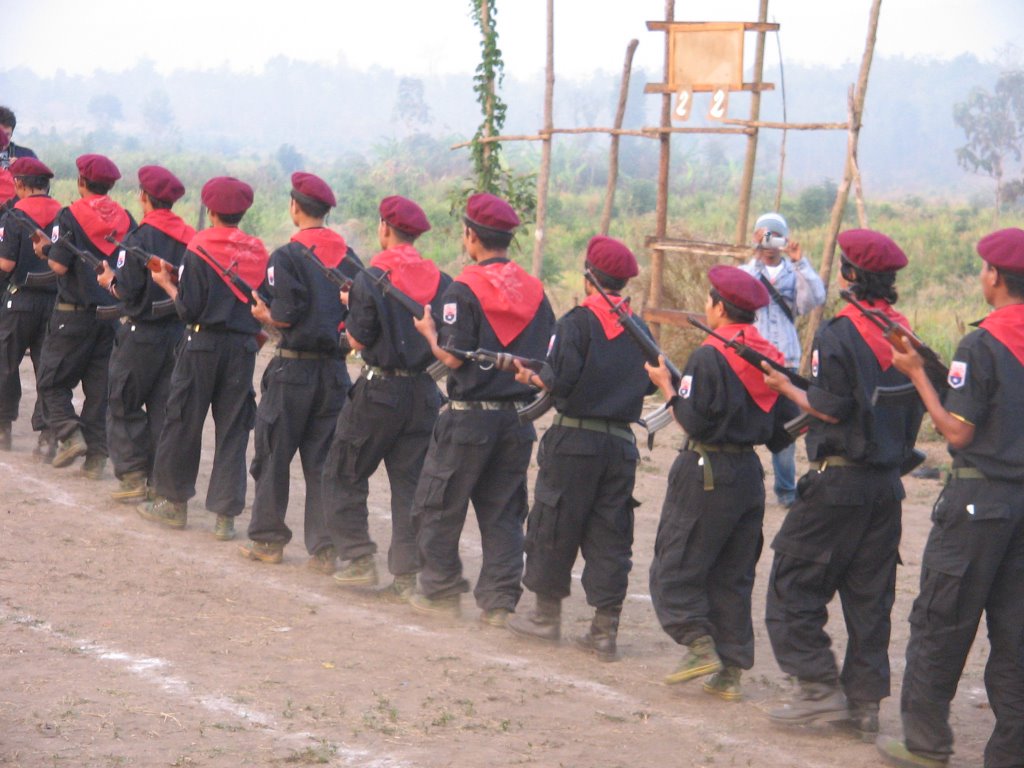
We joined a crowd of people circling the parade round and then the marching began. There were three divisions on parade: two groups of men with guns and one group of women, unarmed and last. Another group of older men in uniform stood at attention along the sidelines with the crowd, and many other soldiers wandered through the crowd with their rifles slung casually over their solders.

A new General was inducted and inspected the troops, the old one was given a memorial tribute through the explosion of three ordinances behind the parade ground.
 Huge clouds of smoke hung in the air afterwards and drifted slowly down the valley. As they raised their flag, a flag most of you will never have seen before and perhaps never will, I heard the most mournful rendition of the national anthem that I have heard sung.
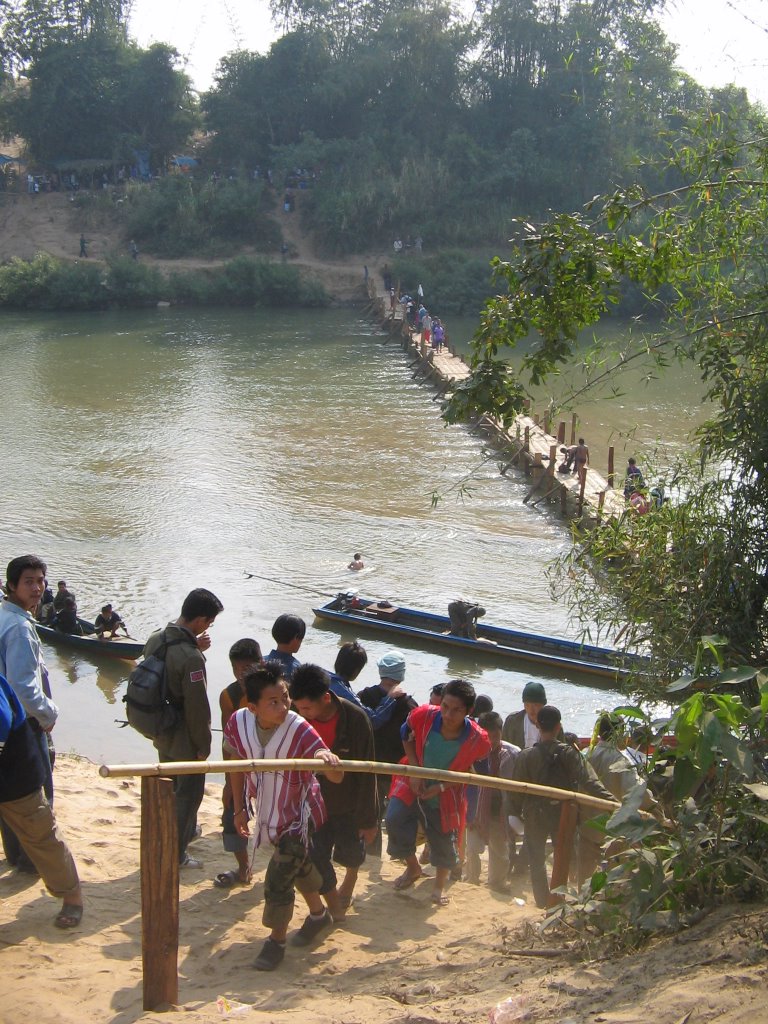 The soldiers dispersed as the day lightened and the serious mood slipped away with the sunshine. People laughed and found old friends again, people took photos and posed with guns. I turned around and there was someone I hadn’t seen in almost a year, and there was an old student running through the crowd to hug me. We sat down together to eat noodles and salty beef curry. It felt like late afternoon, though the morning had hardly broken. We watched dancing, met new friends and old ones and spent a great deal of time on the banks of the river, looking down on the sun on the water and the children playing in the shallows. That scene, like so much around me there, was so powerfully sweet and sad for me.
 Without all the guns, it felt like a lovely day for a party and a picnic. I smiled to see all the young bodies splashing in the sunlight, the older ladies with their sarongs rolled up, wading in after them, the drunk man dripping on the bamboo bridge after falling in. We could have been anywhere celebrating anything, a family reunion, a company picnic, a national holiday. But the fact is we were there, with the river that is also a black line on a map, with a holiday that is all about guns, fifty seven whole years of guns and smoke and fighting without end.

In the daylight, the trip back through the fields was less mysterious and more dusty. The scenery was more spectacular: the river in a valley of bamboo, the mountains beyond that will always be, for me, in the distance, trees rising out of green fields, the brown dirt track wandering it’s way under the dusty blue sky perfumed with the scent of summer-dry grass. Most beautiful though, were the smiles of the good friends I bounced along beside, crammed together in the back of the truck.
I came home and sat out on my balcony after a much needed shower. I had some cool fruit, a good book, and the sunset for company. It was that delicious time of day when everything is quiet and rich and mellow. Everything is peaceful, and I had a better idea, that day, of what peaceful really means. It means that I spent a great deal of my life never seeing a gun, or touching one, or celebrating one. It means my parents took pictures of me with ice skates slung over my shoulder, not a rifle. It means that I never knew a line that divided me, I never knew what it was to be illegal just by breathing in the wrong space, I never had to fight in order to dance, or speak or survive.
January 31st 2006: 57 years of revolution.

Dysentery Diet: Day 4
I amazes me that after four days without eating, the body still has stuff to spew forth. Yet it is so, as I, intrepid adventurer Jones, can, rather unfortunately detest.
On Day 3 I had enough energy to venture out of my house to see a doctor, who informed me that I had, "many things in my intestines." Those "things" are not food, that is all I can say, but the happy purple antibiotics she gave me seem to be working. I can now eat half a bowl of rice porridge a day and walk down the street.
I know, I know, my bowel movements are not exactly your preferred reading or the most exciting topic for a blog, however, they have been the center of my life for the past four days. Since Thursday when I ran out of the class I was teaching to throw up, my entire life has consisted of my sleeping and running to the toilet.
Sounds fascinating, doesn't it? Actually, what's more interesting, is what I MISSED as a consequence of this sudden illness.
1. A big party in Bangkok. I had a bus ticket already bought to go down to the big city on Thursday night for a party on Friday for my old neighbor's photo exhibition opening at the foreign correspondent's Club. While in Bangkok, I planned to visit the dentist, the pharmacist and maybe go out dancing Saturday night.
2. A visit from the Prime Minister of Thailand and 24 foreign dignitaries on Saturday in Mae Sot. I found out about this last minute pleasure from an only slightly harassed UN official I ran into while sweaty and completely disgusting at the local 7-11 where I was stocking up on my oral hydration powder, tylenol and rice porridge supplies.
3. The riots against the Prime Minister (from which he is hiding in Mae Sot) in Bangkok (where I would have been if not for the party in my intestines) of over 100 000 people. The email warning I just read from the embassy warns of impending violence, to stay away from the very area where my proposed dentist is located.
So, on day 4, still existing mainly on a diet of rehydration salts and the occasional spoonful of rice soup, sweaty, but with a fever no longer, I think, dysentery is not the worst thing that could have happened to me this weekend.
Subscribe to:
Posts (Atom)